This article explores how Indigenous youth understand and define leadership, challenging
dominant conceptions that positions leadership as an individual trait or outcome of
capacity-building. Grounded in a decolonial approach, the study draws on a year-long
participatory process with the Youth Advisory Committee of the Quebec Youth Research
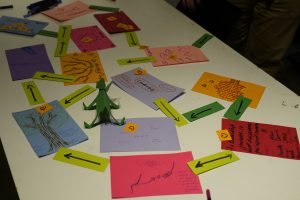
Network Chair’s Indigenous Stream. Through dialogues, creative activities, and group
reflections, youth co-created a visual ‘postcard’ that serves as both a representation and
framework for Indigenous youth leadership. Findings reveal that leadership is understood
as deeply relational, emerging through connections to community, culture, and land. Rather
than a fixed role, leadership is described as a shared and evolving process, shaped through
collective responsibility, intergenerational teachings, and everyday practices of care and
action. Youth emphasize that leadership is cultivated through experiences, including navigating
challenges, stepping into and out of spaces, and learning through both guidance
and relationality. By centering Indigenous youth perspectives, this article highlights the
importance of creating spaces that support diverse expressions of leadership and affirms
the role of youth, as contributing to the collective and to decolonization.
Référence bibliographique
Picard, V., Ibarra-Lemay, A., Bérubé-Therrien, C., & Blanchet-Cohen, N. (2026). Indigenous Youth Voices on Relational Leadership and Guidance. Youth, 6(3), 129.
![Leadership autochtone. [Série de balado]. (2026). Chaire-Réseau jeunesse – CRJ Autochtones.](https://chairejeunesse.ca/wp-content/uploads/2026/09/logo-rassemblement-480x320-1-300x200.png)
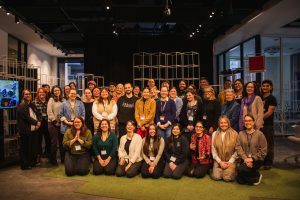
![CRJ Autochtones [vidéo]. (2026, 8 juin). Rassemblement sur l’écosystème du leadership jeunesse autochtone 2025. Bureau de l’engagement communautaire de Concordia.](https://chairejeunesse.ca/wp-content/uploads/2026/09/Image1-300x163.png)